
DTF on Hats & Caps: Curved Surface Press Hacks | DTF Dallas
Jun 23, 2026 (Updated on Oct 8, 2026)
DTF on Hats & Caps: Curved-Surface Press Hacks

Hats and caps are one of the most requested custom apparel items, and one of the most frequently declined DTF jobs at shops that only have flat platen presses.
The challenge is not the fabric or the adhesive. It is the curve. A standard heat press built for flat t-shirts cannot make full contact with a structured cap crown or a rigid brim, which means standard pressing produces incomplete adhesion at the curved edges of the design.
The fix is equipment-specific. Here is the breakdown by cap type, press method, and what actually works.
In This Article
Why a Flat Platen Fails on Caps
A standard flat platen presses evenly against a flat surface. A structured baseball cap has a six-panel crown with a center seam and a curved profile that rises away from any flat surface at the edges.
When you press a transfer onto a curved cap crown with a flat platen, the center of the design contacts the platen directly, but the edges of the design are bridging air. The result: good adhesion in the center, no adhesion at the outer edges.
On a brim, the problem is compounded. The brim curves in two axes. Flat platens produce burn marks, pressure creases, or no adhesion at all depending on the cap stiffness.
The Equipment That Solves It
Hat press (cap press)
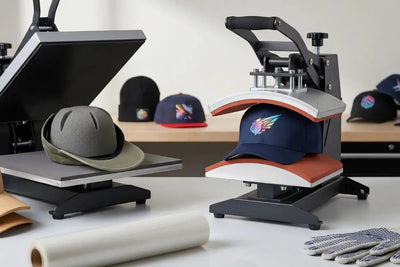
A heat press with a curved lower platen designed to match the profile of a structured cap crown. The upper platen also curves to match. When a cap is loaded onto the curved lower platen and the press closes, both surfaces contact the curved cap simultaneously.
This is the purpose-built solution and the one that produces the most consistent results.
Cap presses are sold as standalone units or as hat press attachments for swing-away heat presses. The curved platen diameter varies by model.
Verify that your cap press matches the crown curvature of the specific cap style you are pressing.
Stuffed crown method (flat platen)
For shops without a dedicated cap press, a dense foam insert or a wooden form that matches the interior crown shape of the cap can be inserted inside the cap.
The cap is then placed face-down over the foam insert, and the flat platen presses against the outside of the crown.
The foam inside pushes the cap face flat against the platen. This method works for smaller designs centered on the front panel where the crown is most nearly flat.
Limitations: the stuffed crown method works best on smaller designs (under 3 inches wide) placed at the center of the front panel. Larger designs that extend toward the panel edges will still have adhesion gaps at the curved perimeter.
Silicone pads on flat platen
A thick, conformable silicone pressing pad placed between the cap and the flat platen distributes pressure more evenly across a slight curve.
This helps on low-profile caps and unstructured hats but is not sufficient for structured high-profile cap crowns.
Cap Types and What Works
- Structured baseball caps (6-panel, high profile): Require a dedicated cap press or the stuffed crown method. The rigid buckram lining in the front panel holds the curve firmly. Designs over 3 inches wide need a cap press for full-edge adhesion.
- Low-profile structured caps: Less curve than a high-profile cap. The stuffed crown method is more effective here. Designs up to 4 inches wide can be pressed with good results using a dense foam insert.
- Unstructured caps and dad hats: The soft, unstructured crown flattens more easily under a flat platen. These are the most forgiving cap styles for DTF without a dedicated cap press. Press with a foam insert inside, designs up to 4 inches.
- Snapbacks (flat bill): The bill is flat, which is an advantage. Brim designs on flat-bill snapbacks can be pressed on a flat platen without the curve problem. The crown still requires a cap press or foam insert for crown designs.
- Beanies: A flat platen with a foam insert inside the beanie works well. Beanies are flexible and conform to the foam insert during pressing. For a full walkthrough of beanie-specific settings, DTF Printing for Hoodies covers the stretch and temperature variables specific to knit fabrics.
Press Settings for Caps
Cap fabric varies by style, but most structured caps use cotton twill, polyester twill, or a poly-cotton blend. DTF Dallas standard settings are 290-310°F, High Pressure 6 sec / Medium Pressure 8-15 sec, Hot Peel. Treat these as your starting point and test on your specific cap fabric before a production run.
For polyester-dominant caps, test at the lower end of the 290-310°F range to reduce dye migration risk. Pressure setting depends on your press type: medium-firm on a cap press; firm when using the foam-stuffed flat platen method.
Cap presses apply pressure differently than flat platens. Verify your cap press is calibrated to deliver consistent pressure across the full platen contact area. Under-pressure on a cap press produces the same adhesion failures as pressing with a flat platen.
For polyester-dominant caps, the temperature range follows the same dye migration logic as athletic jerseys and performance wear. Optimal DTF Heat Press Settings Guide covers the variables that apply across all polyester cap constructions.
Design Placement on Caps
Front center panel: The primary placement. Designs here hit the flattest portion of the cap crown. Standard sizing: 2 to 3.5 inches wide for structured caps, up to 4.5 inches for low-profile or unstructured styles.
Side panels: The curve is more pronounced on the side panels. Keep side-panel designs small (under 2.5 inches) and use a cap press for reliable adhesion.
Back panel: Common for secondary branding. The back panel on adjustable caps typically has a closure (snapback strap or Velcro) that must be folded or removed before pressing. Some closures are heat-sensitive. Check before pressing a back-panel design.
Brim (underside): Occasionally requested for novelty or restaurant branding. Press brim designs on a flat platen. The brim lays flat when removed from the cap and pressed separately, then reattached if it is a removable brim.
The Peel on Caps
Hot peel on most cap applications. Structured caps retain heat in the fabric and buckram lining, giving you a comfortable hot peel window after the press opens. Peel promptly at a sharp angle, pulling the carrier film against the direction of the panel seam rather than across it.
For cap presses where the crown is loaded and pressed in one position, the peel direction follows the same sharp-angle rule. Hold the cap stable on the lower platen while peeling to prevent the fabric from pulling.
Post-Press Finish
After peeling, do a finishing press: place a silicone sheet over the applied transfer and press for 5 seconds. On caps where the initial press may have slightly less even contact than on a flat garment, the finishing press seats the transfer edges and improves adhesion uniformity.
For the full DTF pressing workflow including peel technique, Step-by-Step: Applying DTF Transfers Ready to Press covers the decision points that apply to curved-surface pressing as well.
Ordering Hat Transfers
DTF Dallas produces custom DTF transfers for caps, hats, and beanies sized to your specific placement dimensions. Same-day production on print-ready files before 2:00 PM CT. For multi-placement hat orders or team cap jobs, the gang sheet builder lets you configure multiple hat designs on one sheet before ordering.
Frequently Asked Questions
Can I press DTF on caps without a dedicated cap press?
Yes, for smaller designs. Use the stuffed crown method with a dense foam insert, or a silicone pressing pad on a flat platen. These work best for designs under 3 inches wide centered on the front panel. Structured high-profile cap crowns and larger designs need a dedicated cap press for full-edge adhesion.
Why won't the edges of my cap design stick?
A flat platen only contacts the center of a curved cap crown, while the edges of the design bridge air and get no pressure. This gives you good adhesion in the center and no adhesion at the outer edges. A cap press, stuffed crown method, or silicone pad fixes the contact problem.
What temperature and time should I use for DTF on caps?
DTF Dallas standard settings are 290-310°F, High Pressure 6 sec / Medium Pressure 8-15 sec, with a Hot Peel. For polyester-dominant caps, test at the lower end of the range to reduce dye migration risk. Always test on your specific cap fabric before a production run.
How large can a cap design be?
Front center panel sizing is 2 to 3.5 inches wide for structured caps, up to 4.5 inches for low-profile or unstructured styles. Keep side-panel designs under 2.5 inches because the curve is more pronounced there.
Does DTF Dallas make transfers sized for hats?
Yes. DTF Dallas produces custom DTF transfers for caps, hats, and beanies sized to your specific placement dimensions, with same-day production on print-ready files submitted before 2:00 PM CT.
Need Cap-Ready Transfers?
Order custom DTF transfers sized for your caps, hats, and beanies. Same-day production before 2:00 PM CT.
Order DTF Transfers
Comments 0
Be the first to leave a comment.