
DTF Powder Demystified: How Much, When to Skip, Why It Matters
Jun 24, 2026 (Updated on Oct 8, 2026)
If you are producing your own DTF transfers rather than purchasing pre-made ones, the powder step is where most beginners make their first mistake.
The hot-melt adhesive powder is not an accessory. It is the adhesive. Without it, or with too much of it, the transfer either will not bond or will produce a stiff, gummy result.
Here you'll find:
What DTF Powder Is
DTF hot-melt adhesive powder is a thermoplastic polymer, polyurethane-based, in granular form. When applied to a freshly printed DTF film and then heated in a curing oven or heat drawer, the powder melts and forms a continuous adhesive layer on the surface of the ink. That adhesive layer is what bonds the transfer to fabric fiber during heat press application.
The powder has two properties that matter: it melts below standard DTF press temperature, and it bonds strongly to fabric fiber under the heat and pressure of a full press application. This combination of a low melt point to activate and full bond under press pressure is what makes DTF transfers work.
Powder Types
- Fine powder (small particle size): The most common choice for most DTF applications. Fine powder melts more evenly, produces a thinner adhesive layer, and results in a softer hand feel. Better for small detail work and thin designs where hand feel matters.
- Coarse powder (large particle size): Produces a thicker adhesive layer. More durable on rough or textured substrates where a thin adhesive layer may not achieve full contact. Coarser powder can produce a stiffer hand feel and may show a slightly more textured surface on the applied transfer.
- Hot-melt vs cold-peel-specific formulations: Some powder formulations are designed for cold peel applications. They have a higher melt point or modified flow characteristics that keep the adhesive slightly firmer during the press, allowing for cleaner cold peeling. If your transfers are designated cold peel, verify your powder formulation matches that requirement.
The Application Process
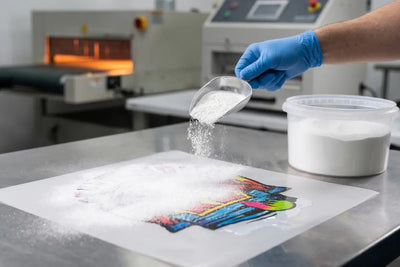
DTF powder is applied immediately after printing, while the ink is still wet. The wet ink surface acts as a temporary adhesive to hold the powder particles in place.

Method 1: Powder bin shake. Hold the printed film over a powder bin and coat the ink surface by hand, then shake or tap off the excess. The ink surface holds what it can support. Excess falls back into the bin.
Method 2: Automatic powder applicator. High-volume DTF setups use an automatic powder shaker that applies powder consistently and recovers excess automatically. More consistent than hand application for production runs.
After applying powder, shake or tap the film to remove any particles that did not adhere to the wet ink. Excess loose powder on the film bonds to the carrier film rather than the ink when cured, creating gummy or rough surface spots.
Curing the Powder
After powder application, the film goes through a curing process that melts the powder into a continuous adhesive layer. Common curing methods:

Curing oven or tunnel curer: The film passes through a heated environment at a set temperature and dwell time. Cure temperature varies by powder formulation, but is generally below standard press temperature. Insufficient curing leaves the powder granular rather than melted, which means the adhesive layer is not continuous and adhesion will be inconsistent.
Heat drawer or infrared curer: Alternative curing tools used in smaller production setups. The principle is the same: heat the powder above its melt point, then allow it to fuse into a continuous layer before cooling.
After curing, the adhesive layer should be smooth and slightly glossy. Granular texture after curing indicates under-cure. Bubbling or discoloration indicates over-cure or contamination.
Too Little Powder: What Happens
Under-powdered transfers do not have enough adhesive to bond reliably to fabric. The result:
- Transfer appears to bond during pressing but lifts immediately after the press opens
- Design peels away with the carrier film
- Partial bonding where powder was present, complete failure where it was not
- Edge lifting in the first wash cycle even if the center held initially
If you consistently get design lift or carrier-film peel failures and your press settings are correct, insufficient powder coverage is the most likely cause.
Too Much Powder: What Happens
Over-powdered transfers have an adhesive layer that is thicker than needed. The excess adhesive still bonds to fabric, but the results are:
- Hard, plastic-feeling hand feel after pressing
- Visible adhesive at design edges (gummy border effect)
- Slower melt during pressing, sometimes requiring longer press time
- Adhesive spreading beyond the design boundary during pressing
The fix for over-powdering is in the application. Shake more aggressively before curing to remove excess powder. Once the transfer is cured, the extra adhesive is permanent. If your transfers are consistently producing a stiff, plastic feel after pressing, DTF Printing Troubleshooting Guide: Fix These 12 Common Problems Fast covers all four causes including excess powder in detail.
Can You Skip the Powder?
No. Without the adhesive powder, there is nothing to bond the ink film to the fabric. The DTF ink layer by itself has no adhesive properties. A transfer pressed without adhesive powder will press flat against the fabric but lift completely when the carrier film is peeled or when the garment is handled.
The powder is not optional. It is the mechanism.
Powder and Pre-Made Transfers
If you are purchasing ready-to-press DTF transfers from a supplier like DTF Dallas rather than producing your own, the powder step has already been done.
The transfer arrives with the adhesive layer fully cured and ready for your heat press. You do not add powder, you do not cure. You only press.
For buyers who are curious about the production process behind the transfers they are pressing, understanding the powder step explains why the adhesive feels the way it does and what the supplier's quality control process involves.
For the pressing workflow that follows powder application, Step-by-Step: Applying DTF Transfers Ready to Press covers the press and peel sequence from start to finish.
Ordering Finished Transfers
DTF Dallas handles the full DTF production workflow: printing, powdering, curing, and quality checking, before transfers ship or go to the pickup shelf.
Custom DTF transfers are available with no minimums and same-day production on print-ready files submitted before 2:00 PM CT.
For multi-design orders, the gang sheet builder consolidates your full print run on one sheet.
Order Finished, Ready-to-Press Transfers
Printed, powdered, cured, and quality-checked. No minimums. Same-day production before 2:00 PM CT.
Get a Custom Quote
Comments 0
Be the first to leave a comment.