
What Heat Press Do You Need for DTF Transfers?
May 25, 2026 (Updated on Oct 8, 2026)
The heat press is the piece of equipment that determines whether your DTF transfers look professional or come out cracked, peeling, or uneven.
You can order the best transfers available, but if you're pressing with a machine that can't hold a consistent temperature or apply even pressure across the platen, you'll blame the transfer for problems the press is causing.
This guide covers
- Why the heat press matters as much as the transfer
- The three press types (clamshell, swing-away, draw)
- Platen size: what you actually need
- Temperature accuracy: the spec that matters most
- Pressure: even distribution across the full platen
- What not to use for DTF transfers
- Fabric-specific settings quick reference
- A note on ancillary equipment
Why the Heat Press Matters as Much as the Transfer
DTF transfers work through a thermally activated adhesive process. The TPU powder fused to the back of the transfer melts at temperature, bonds to fabric fibers, and re-solidifies as it cools. If any part of that sequence is off, including temperature too low, pressure too light, or uneven contact across the transfer, the bond is incomplete.
Incomplete bonding shows up in specific, predictable ways: edges that lift after washing, sections of the design that peel away, or a plastic-feeling print that hasn't properly embedded into the fabric. Most of these failures are not transfer quality issues. They're press issues.
The good news is that DTF is forgiving of a wide range of equipment as long as the equipment can hold calibrated, consistent temperature and apply firm, even pressure. You don't need a $3,000 industrial press to produce professional results. You do need a press that does its job reliably.
The Three Press Types
Clamshell Press
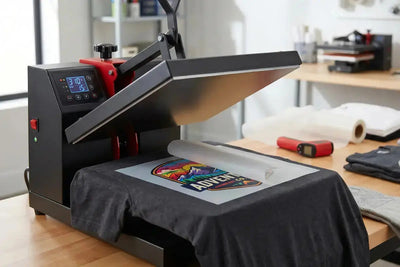
A clamshell press opens and closes vertically, like a clamshell. The upper platen lifts from the back hinge and comes down directly onto the lower platen. This is the most common design for entry and mid-level heat presses.
Advantages: Compact footprint, lower cost at equivalent platen size, simple operation.
Limitations: The opening angle creates a slight challenge when loading garments. On some clamshell designs, the platen applies slightly more pressure at the front (closest to you when loading) than at the back hinge side. On quality presses this is compensated for in the design; on budget presses it often isn't.
For DTF work, clamshell presses work fine if the pressure is consistent across the platen. The best way to test this is to press a full-surface transfer and check all four corners and the center for consistent adhesion.
Swing-Away Press
A swing-away press has an upper platen that swings horizontally to the side when open, completely clearing the lower platen. This gives you full, unobstructed access to position your garment and transfer.
Advantages: Easiest garment loading, more ergonomic for high-volume work, better platen clearance for thick or seamed garments (jackets, hoodies). The pressing mechanics on swing-away presses tend to produce more even pressure distribution than clamshells at the same price point.
Limitations: Larger footprint than a comparable clamshell. Higher cost at equivalent platen size.
For anyone doing volume work or pressing on items that are harder to position, swing-away is worth the premium. For a home crafter or small-batch seller doing a few dozen shirts per week, clamshell works fine.
Draw Press (Drawer Style)
A draw press slides the lower platen out toward the operator like a drawer, allowing you to load the garment on the extended platen before sliding it back under the upper platen to press. Common in commercial production environments.
Advantages: Fast, ergonomic production workflow. Consistent pressure. Operator's hands never go near the upper platen.
Limitations: Higher cost. Less common in the home or small-business market.
If you're setting up a production operation doing 50 or more shirts per day, a draw press is worth evaluating. For lower volumes, clamshell or swing-away covers the need.
Platen Size: What You Actually Need
The platen is the heated surface that makes contact with the transfer. Its size determines what you can press in a single cycle.
- 11" x 15": The standard size for most entry and mid-level presses. Works for full front chest prints on adult tees, back prints up to about 14" wide, and most standard DTF transfer sizes. This is the minimum useful size for serious DTF work.
- 15" x 15": A step up that covers full-back prints, oversized front graphics, and most adult garment applications. If you're primarily pressing shirts and hoodies, 15" x 15" handles almost everything.
- 16" x 20": Commercial standard. Covers large back prints, full over-the-shoulder designs, and bulk production efficiency. Necessary if you regularly press large transfers or want to press wider designs in one cycle.
- Smaller than 11" x 11": Useful for caps, pocket prints, and small-format specialty items, but insufficient as your only press for full-front shirt production. A 9" x 12" press marketed as a "starter" will leave you pressing a shirt in two sessions to cover the full front, which creates visible seam lines and inconsistent adhesion at the overlap zone.
For most small businesses and independent sellers, start with 15" x 15". It covers enough surface area to handle typical DTF transfer sizes without repositioning and without paying for more capacity than you need.
Temperature Accuracy: The Spec That Matters Most
A press is only as useful as its ability to hold a specific temperature.
Most DTF transfers are pressed in the 290–310°F range, depending on the transfer, fabric, and supplier instructions. Typical press times often fall around 8–15 seconds, but some transfers may require different timing. Always follow the instructions supplied with your transfer.
A press that cannot hold a stable temperature will give you inconsistent results: adhesive that doesn't activate fully on the low end, or transfers and fabric damaged on the high end. Look for presses rated at plus or minus 5°F variance.
How to evaluate temperature accuracy
- Variance rating: Look for presses rated at plus or minus 5°F variance. Quality mid-level presses achieve this.
- Independent verification: Buy an infrared thermometer (under $30) and verify your press's actual platen temperature against the display. This is a one-time calibration step every serious DTF operator should do.
- Digital over analog: Digital readout is more reliable than analog dial. Analog dials on budget presses are frequently inaccurate.
A press that reads 310°F but actually runs at 295°F will consistently under-press DTF transfers, producing weak adhesion and early peeling. Many application failures attributed to bad transfers are actually miscalibrated presses.
Pressure: Even Distribution Across the Full Platen
DTF transfers require firm, even pressure across the entire contact surface.
- Cotton: approximately 60 PSI
- Polyester: approximately 40 PSI
- Blends: approximately 50 PSI
Most presses don't express pressure in PSI directly. They use a numbered dial or knob that corresponds to a pressure range.
A useful test: cut a sheet of paper into four quarters, place them at the four corners of the lower platen, close the press to your working pressure, and try to slide each piece out. All four should offer the same resistance. If a corner slides out easily while others don't, pressure distribution is uneven.
On clamshell presses, the most common issue is less pressure at the back of the platen near the hinge. On budget swing-away presses, pressure can be inconsistent across the full surface. Test your press before assuming the problem is your transfers.
What Not to Use for DTF Transfers

A standard clothes iron
Temperature is uneven, cannot hold a specific setting, and pressure is applied manually with no consistency. Irons produce unpredictable results with DTF and should not be used for customer-facing work.
Cricut EasyPress or similar handheld presses
Cricut EasyPress or similar handheld presses can work for small personal DTF projects, but they are not ideal for full-size designs or customer orders because pressure is applied manually. For consistent adhesion, especially on larger transfers, a professional heat press is recommended.
An underpowered press for your garment type
A 9x9 press struggling to cover a 10-inch transfer with two press cycles will leave a visible line at the overlap. Match your press size to your most common transfer size before buying.
Fabric-Specific Settings Quick Reference
These ranges are general guidance for DTF transfers across the most common fabric types. Always confirm with the instructions supplied by your transfer manufacturer, since specific products may require different settings.
| Fabric | Temperature | Pressure | Press Time |
|---|---|---|---|
| Cotton | 290–310°F | ~60 PSI | 8–15 seconds |
| Polyester | 290–310°F | ~40 PSI | 8–15 seconds |
| Cotton/Poly Blends | 290–310°F | ~50 PSI | 8–15 seconds |
If your transfer's instructions specify different settings, follow those instead. Supplier guidance always overrides general references.
A Note on Ancillary Equipment
Two pieces of supporting equipment that improve DTF results significantly:
Teflon sheets or cover sheets
Use the cover sheet recommended with your transfer, such as parchment or a Teflon sheet, especially for post-pressing. This protects the print surface and helps distribute pressure more evenly. Post-press with the cover sheet for 5 seconds after removing the carrier film to improve hand feel. DTF Dallas carries Teflon protective sheets in its supplies section.
Infrared thermometer
As mentioned, verify your press's actual temperature against the display. A $20 to $30 IR thermometer is the most cost-effective quality control step you can take.
Once your press is calibrated and you're using the right settings for your fabric, DTF becomes a consistent, repeatable process. The transfers from DTF Dallas are available by size or as gang sheets depending on your production volume. Get your press dialed in first, then order transfers with confidence.
Ready to Order DTF Transfers?
Same-day shipping on eligible orders before 2:00 PM CT · 24/7 pickup in Richardson · No minimums
Shop DTF transfers →
Comments 0
Be the first to leave a comment.