
UV DTF Cup Wraps Guide: How to Size, Design and Apply Them Right
May 22, 2026 (Updated on May 23, 2026)
UV DTF cup wraps have become a popular product category in custom drinkware, and the application process trips up a lot of first-time users. Not because it's difficult, but because it's different from pressing standard fabric transfers.
The materials behave differently, the prep steps matter more, and a few common mistakes can ruin an otherwise clean wrap.
This guide covers
- What UV DTF cup wraps are (and what they are not)
- What surfaces cup wraps work on
- How to measure your cup for a wrap
- Setting up your design file
- Step-by-step application process
- Common mistakes and how to avoid them
- Ordering from DTF Dallas
- Durability and care
What UV DTF Cup Wraps Are
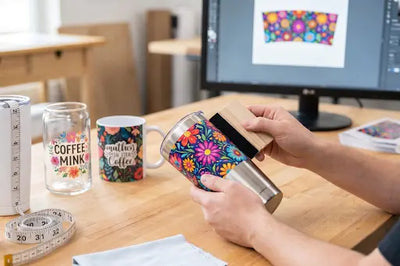
A UV DTF cup wrap is a printed adhesive transfer supplied on carrier film designed to wrap around the circumference of a hard surface. The most commonly used: tumblers, straight-wall cups, mugs, and water bottles.
The "UV DTF" name comes from the printing process: UV-curable inks are printed directly onto a special PET film with an adhesive layer, then transferred to the surface without heat.
Unlike fabric DTF transfers, UV DTF uses a pressure-sensitive adhesive that bonds to smooth, non-porous surfaces with no heat press involved. You peel, apply, squeegee, and you're done.
What UV DTF Cup Wraps Are Not
They are not cut vinyl decals or sublimation paper. Each of those requires different equipment, different surfaces, or a different application process entirely.
They are also not the same as standard fabric DTF transfers. Standard DTF uses a hot adhesive powder that bonds to fabric fibers under heat. UV DTF skips the heat entirely: the adhesive is pressure-sensitive, not heat-activated.
What Surfaces Cup Wraps Work On
UV DTF cup wraps adhere best to smooth, non-porous surfaces with minimal texture variation; they are specifically engineered for drinkware surfaces. When applied correctly, they produce vibrant, detailed prints that sit flush against the surface with no lifting or bubbling.

For powder-coated stainless tumblers, which is the dominant product category in this market, UV DTF wraps apply cleanly and produce excellent results when sized correctly.
How to Measure Your Cup for a Wrap
Incorrect sizing is the most common reason a wrap doesn't fit or leaves a visible gap. Here's how to measure properly.

- Circumference: Wrap a flexible measuring tape around the widest point of the cup. This is your wrap width. For a standard 20 oz straight-wall tumbler, circumference is typically 9.5 to 10 inches. For a 30 oz tumbler, expect 11 to 11.5 inches. Don't estimate, measure the specific cup you're applying to.
- Height: Measure the usable height of the cup exterior, from just above the base ring to just below where the lid or tapered top begins. Most wraps leave a small margin at top and bottom to avoid the curved edges where adhesion is weaker.
- Taper consideration: Straight-wall cups are the easiest to wrap. Tapered cups, where the top diameter is wider than the base, require a tapered wrap design to prevent bunching. Most vendors sell wraps sized for specific popular cup models, which handles this automatically. If you're ordering custom wraps for a specific cup, provide both the top diameter, bottom diameter, and height so the design can be sized with the right taper.
If you need a custom size, DTF Dallas carries UV DTF cup wraps in standard sizes for the most popular tumbler formats.
Setting Up Your Design File for Cup Wraps
A few technical requirements that matter before you order:
- Resolution: 300 DPI minimum. UV DTF printing captures fine detail, but it can only reproduce what the file contains. Low-resolution artwork will produce visible pixelation on a wrap.
- Color mode: UV DTF printers use CMYK ink sets, so designing in CMYK gives you the most predictable results. RGB files are accepted and the shop's RIP software will handle the conversion, but vibrant colors like neon greens and electric blues can shift in the process. For color-critical artwork, convert to CMYK and soft-proof before submitting.
- File format: PNG with a transparent background is ideal. The shop needs to see exactly where your design begins and ends to ensure correct placement and sizing.
- Bleed and wrap edge: Build a small bleed (1/8 inch minimum) beyond the intended crop line. When the wrap is applied, the very edge of the adhesive layer needs full coverage to prevent lifting. Designs that run right to the trim edge can leave a visible gap at the seam.
- Seam planning: The wrap has a seam where the two ends meet. Plan where on the cup that seam will fall. Most people position it toward the back of the cup, the side away from the handle or main logo. Make sure your design doesn't have a critical element that gets cut at the seam.
Step-by-Step Application Process
UV DTF cup wraps have two film layers: the printed adhesive design stays on the cup; the top carrier film (A film) is removed after firm application, and the B film is the release liner on the back. Understanding which film does what is essential before you start.

-
Clean the cup surface
Use isopropyl alcohol at 70% concentration on a lint-free cloth to wipe the exterior surface of the cup. This removes oils, fingerprints, and any residue that would prevent the adhesive from bonding. Let it dry completely before continuing.
-
Peel the B film (release liner) partially
Fold back roughly one inch of the B film from one end of the wrap to expose the adhesive layer. Do not remove the entire B film at once or the wrap will be impossible to position.
-
Position and align
Align the exposed adhesive end of the wrap with your starting point on the cup. On a straight-wall tumbler, start at the seam position you chose. Make sure the wrap is level horizontally before pressing down. A slight misalignment at the start will be amplified as you work around the cup.
-
Work around the cup
Once the starting position is set, slowly peel back the B film while pressing the wrap firmly against the cup surface as you go. Work in a continuous motion around the cup, pressing out air as you advance.
-
Squeegee out air bubbles
Use a squeegee, credit card, or firm flat object to press the wrap firmly from the center outward toward the edges. Work in overlapping passes. Small air bubbles can be pushed out by applying firm, even pressure. Large bubbles may indicate misalignment, trapped moisture, dust, or applying too quickly.
-
Press the seam
When both ends of the wrap meet, press the seam firmly with your fingernail or a burnishing tool. A clean, firm seam that lies flat is the goal. A gap at the seam means the wrap was cut slightly short and will need to be re-ordered at the correct size.
-
Final press and A film removal
Run your thumb or the squeegee firmly over the entire wrap surface one more time to ensure full contact and eliminate any remaining air. The A film on top protects the print during application: leave it in place until you've confirmed the wrap is fully adhered. To remove the A film, peel slowly from one corner at a low angle. Pull it parallel to the cup surface rather than lifting up at a steep angle.
Common Mistakes and How to Avoid Them
Using alcohol above 70%
Higher concentrations don't evaporate cleanly and can leave a film on the surface that prevents adhesion. 70% isopropyl is the correct choice.
Not letting the surface dry after cleaning
Moisture under the wrap creates bubbles that can't be pressed out. Give the surface 30 to 60 seconds to dry completely after wiping.
Removing the entire B film before positioning
Once the full adhesive layer is exposed, the wrap becomes difficult to handle and easy to fold onto itself. Peel and apply incrementally.
Rushing the seam
The seam is the most visible part of a wrap job. Take the extra 30 seconds to align it cleanly and press it firmly.
Applying to a cold cup
If your stainless tumbler just came out of the refrigerator, let it come to room temperature first. Cold surfaces reduce adhesive tack and can cause early edge lifting.
Ordering UV DTF Cup Wraps From DTF Dallas
DTF Dallas offers both standard-size UV DTF cup wraps for popular tumbler formats and custom orders for specific sizes and designs.
For orders where you need multiple designs on a single film sheet, the UV DTF gang sheet option allows you to combine designs and lower the cost per wrap. This is especially useful for sellers who offer several different cup wrap designs, or for event orders where each recipient gets a personalized version.
For a broader look at UV DTF applications beyond drinkware, the UV DTF stickers guide covers the full range of hard-surface UV DTF products and how they differ from each other.
Durability and Care
Properly applied UV DTF cup wraps are durable under normal use conditions. Hand wash only is recommended. Avoid dishwasher, soaking, boiling water, and abrasive scrubbing. What shortens their life: submerging in boiling water, prolonged dishwasher exposure (the heat and detergent combination degrades adhesion over time), and extended soaking.
For tumblers used daily, the practical durability of a well-applied UV DTF wrap is measured in years, not weeks. For gift items that will be used occasionally, durability is not a concern at all.
The application process has a learning curve of about five to ten wraps. After that, it becomes straightforward and fast. The quality of the wrap itself and the underlying adhesive determine how clean the finished product looks far more than application technique. Start with a quality wrap, follow the cleaning and application steps, and the results are consistent.
Order UV DTF Cup Wraps
Same-day shipping on eligible orders before 2:00 PM CST · 24/7 pickup in Richardson · No minimums
Shop UV DTF cup wraps →Comments 0
Be the first to leave a comment.