

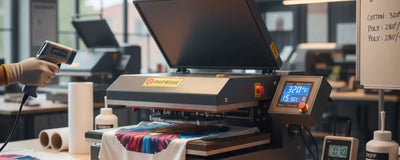
Optimizing your dtf heat transfer temperature is the most critical step for any DFW print shop owner looking to eliminate production waste and ensure garment longevity. In the high-speed Dallas market, you cannot afford to have transfers peeling or fabrics scorching because of uncalibrated equipment.
Whether you are branding heavy workwear in Fort Worth or performance jerseys in Frisco, your heat press settings dictate the strength of the chemical bond between the ink and the fiber.
This guide provides a definitive heat press temperature chart and industrial troubleshooting tips to help you get a perfect "bite" into the fabric on every press.

Reference
The Master DTF Heat Press Temperature Chart
Use this chart as your primary reference point. We have included the Peel Type for each substrate to help you streamline your production line.
Press Settings by Substrate
DTF Dallas Calibration Card
| Fabric Type | Temperature | Time (Sec) | Pressure | Peel Type |
|---|---|---|---|---|
| 100% Cotton | 300°F - 320°F | 12 - 15 | Heavy · 60 PSI | Instant Cold |
| 100% Polyester | 265°F - 280°F | 10 - 12 | Medium · 40 PSI | Instant Cold |
| 50/50 Blends | 285°F - 300°F | 12 | Med-Heavy · 50 PSI | Instant Cold |
| Tri-Blends | 275°F - 290°F | 10 - 12 | Medium · 40 PSI | Instant Cold |
| Nylon / Spandex | 250°F - 265°F | 8 - 10 | Light-Med · 30 PSI | Instant Cold |
Film Removal
The Rule of the Peel: Hot vs. Cold
Before you lock your press, you must understand the "Peel Rule." The timing of the film removal is just as important as the dtf heat transfer temperature.
Cold Peel
Standard Safety
Most professional-grade films used in North Texas are Cold Peel. You must allow the transfer to reach room temperature before removing the carrier sheet.
- WhyThis allows the TPU adhesive to fully re-solidify and "lock" onto the fabric fibers.
- Pro TipUse a chalkboard eraser or a cold metal plate to "heat sink" the garment and speed up the cooling process.
Hot Peel
High-Volume Production
Hot Peel films allow you to remove the sheet within 1 to 2 seconds of opening the press.
- The RiskHot peeling requires a perfectly calibrated press. If your platen has "cold spots," the ink will lift with the film.
- The RecommendationIf you aren't 100% sure of your equipment's consistency, always default to a cold peel to ensure the highest detail retention.
By Substrate
Setting Up for Success: Fabric Specifics
1. 100% Cotton: The "Bite" Factor
Cotton is a durable, natural fiber that thrives at higher temperatures (around 310°F).
- Pre-Press for HumidityDFW humidity causes cotton to hold moisture. Always perform a 5 to 8 second pre-press to "de-gas" the fabric before applying the transfer.
- Maximize PressureUse heavy pressure. You should see the faint texture of the cotton weave through the ink after the final press.
2. Polyester & Blends: Avoiding the "Box"
Synthetics are heat-sensitive. If you use cotton settings on a polyester jersey, you will likely scorch the fabric or cause dye migration (where the shirt color bleeds into the white ink).
- Lower the HeatLimit your polyester settings to a maximum of 280°F.
- Check for Dye MigrationIf your white ink looks pink on a red shirt, drop your temperature by 10°F and add 3 seconds to your timer.
The Variable
Pressure Settings: The Underrated Variable
Temperature prepares the glue, but pressure settings finish the bond. We categorize pressure into three industrial levels:
Light · 20-30 PSI
Used for delicate nylons or items with zippers and seams that might break under load.
Medium · 40-50 PSI
The standard for polyester and performance blends.
Heavy · 60+ PSI
Mandatory for 100% cotton and heavy hoodies.
The One-Finger Test
If you can lock your manual heat press with a single finger, you do not have enough pressure for a professional DTF transfer. You should need to engage your body weight to lock the handle.
Diagnostics
Troubleshooting Checklist: Why Isn't It Sticking?
If your transfers are lifting, use this diagnostic checklist to fix your pressing parameters:
Diagnostic Checklist
- Verify TemperatureUse an infrared thermometer to check your platen. Many older presses have a 20°F variance between the center and the corners.
- Increase Pre-PressIf you see bubbling, moisture is trapped in the fibers. Increase your pre-press to 10 seconds.
- Adjust for SeamsIf you are pressing near a zipper or a heavy seam, the platen isn't hitting the transfer. Use a heat press pillow to level the surface.
- Perform a Second PressAlways perform a 5-second post-press with a Teflon sheet. This "sets" the ink and creates a soft, retail-ready hand-feel.
DFW
The Local Advantage for DFW Shops
In Dallas, waiting a week for a reprint isn't an option. Integrating a local partner like DTF Dallas into your production line offers distinct benefits:
- Climate ConsistencyWe use films and powders tested specifically for the Texas environment.
- Same-Day SolutionsIf you encounter a failure, you can pick up a replacement gang sheet in Richardson or Arlington the same afternoon.
- Reliable SupportWe know the difference between a "Lone Star" work shirt and a moisture-wicking golf polo.
Consistency is the hallmark of a professional DFW print shop. By following this heat press temperature chart and adjusting for your specific substrate, you ensure that every garment leaving your facility meets industrial standards. Don't guess, calibrate your equipment and follow the science of the bond.
Need your transfers today? Order your DTF Dallas Custom Transfers and experience the fastest turnaround and most stable films in the DFW metroplex.

Questions
FAQ: DTF Heat Transfer Temperature
Can I use a home iron for DTF?
No. A home iron cannot provide the consistent dtf heat transfer temperature or the 60 PSI of pressure required for an industrial-grade bond.
What happens if I press for too long?
Over-pressing can "thin out" the adhesive and cause it to soak too far into the garment, making the colors look dull or causing the ink to crack prematurely.
Why do my colors look different after pressing?
Heat can slightly shift the color of the ink. If the shift is dramatic, your temperature is likely too high, or you are using too much pressure on a synthetic fabric.


