

DTF vs. Screen Printing: Which is Best for Your Business?
Jan 5, 2026 (Updated on Jan 25, 2026)
Deciding between dtf vs screen print is the most critical strategic choice for any Dallas-Fort Worth print shop looking to maximize profit in 2025. In a market where speed is the ultimate currency, the technology you choose determines whether you can profitably fulfill a last-minute order for a Plano corporate event or a large-scale run for a Fort Worth festival.
While traditional screen printing remains an industry staple, digital dtf transfers have fundamentally changed the rules for local decorators by eliminating the bottleneck of screen preparation.

The 30-Second Verdict: Which Tool for the Job?
If you are in a rush, use this quick-reference table to decide which method fits your current project.
|
Feature |
Choose DTF Transfers If... |
Choose Screen Printing If... |
|
Order Size |
1 to 100 pieces (Small to Mid-run) |
100+ pieces (Bulk production) |
|
Design Detail |
High-detail, gradients, or photos |
Bold, simple, or spot-color logos |
|
Turnaround |
Same-Day or Next-Day |
7–14 days (minimum) |
|
Setup Cost |
$0 (No screen or art separation fees) |
$25–$50 per color/screen |
|
Fabric Type |
Anything (Cotton, Poly, Nylon, Blends) |
Primarily Cotton or high-cotton blends |
Cost Comparison: Where Do You Actually Make Money?
For DFW shop owners, the "break-even point" is the most critical metric. In 2025, the labor and material costs of these two methods diverge sharply based on quantity.
Small Batches (1–100 pieces)
DTF wins decisively. Because DTF requires zero setup, your cost per shirt remains fixed and predictable. In screen printing, a 4-color design on 20 shirts can cost you $150 in setup fees alone before you pull a single squeegee. By using dtf transfers, you bypass these "hidden costs" and keep your margins high on short runs.
Bulk Runs (500+ pieces)
Screen printing takes the lead. Once you burn your screens and calibrate the press, the "run charge" (ink and labor per pull) is significantly lower than DTF consumables. For massive, 1-color orders, screen printing remains the most economical path.
The Break-Even Point
The financial "flip" typically happens around 100 units for multi-color designs. If your typical order is a 30-piece run for a local Frisco sports team, stick with DTF to maximize your hourly revenue.
Understanding the Core Technical Differences
Understanding the mechanics helps you explain the value to your customers.
- Screen Printing (Analogue): This method uses a physical mesh screen for every color. Technicians burn a stencil into the mesh and push ink through it onto the garment. This requires intensive prep: degreasing, coating, burning, and eventually reclaiming screens.
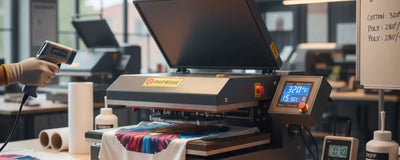
- DTF Printing (Digital): Our industrial printers apply full-color CMYK ink plus a white base directly to a PET film. We then apply a TPU adhesive powder that bonds the ink to the fabric. You skip the darkroom entirely and move straight to the heat press.
Color, Detail, and Vibrancy
DTF captures microscopic details (down to 1-pixel lines) that traditional screen printing mesh often chokes on. If your client provides a design with glows, drop shadows, or photographic gradients, use dtf transfer technology to ensure every detail makes it onto the shirt.
Screen printing excels at exact PMS (Pantone) matching because you physically mix the ink colors. While DTF transfers uses advanced color profiles to achieve incredible accuracy, screen printing remains the preferred choice for massive corporate brands with strict color requirements.
Durability: The 50-Wash Standard
There is a persistent myth that digital transfers don't last. At DTF Dallas, we use premium TPU adhesives and high-stretch inks that prove otherwise.
- Screen Printing Durability: Often outlasts the garment itself. The ink becomes part of the fiber, making it the champion for heavy-duty workwear.
- DTF Transfer Durability: Independent testing rates professional DTF for 50 to 60 industrial washes. The transfer remains flexible and resists cracking, even on stretchy performance fabrics.
The Local Advantage: Why Choose DTF Dallas
In Dallas, "shipping from out of state" is a risk you don't need to take. Integrating a local partner like DTF Dallas into your workflow offers three distinct advantages:
- Same-Day Pickup: If a customer calls with an emergency for an Irving trade show, you can upload your art in the morning and pick up your transfers in the afternoon at our Richardson location.
- No Shipping Delays: Avoid the "FedEx lag." Pick up your gang sheets locally and start pressing immediately.
- Local Support: We know the DFW market. We understand your deadlines because we operate in the same zip code.
Diagnostic Checklist: Which Method Should You Quote?
Use this 3-step checklist before sending your next quote to a client:
- Count the Colors: Is it a 6-color logo with gradients? Quote DTF.
- Check the Timeline: Does the client need it by Friday? Quote DTF.
- Verify the Fabric: Are you printing on 100% polyester "dry-fit" gear? Quote DTF to avoid dye migration issues common in screen printing.
In the dtf vs screen printing debate, the "winner" is the method that puts the most profit in your pocket. For the high-color, fast-turnaround, and small-batch orders that dominate the DFW market today, DTF is your most powerful tool.
DTF Dallas isn't just a supplier; we are your local production partner. We handle the technical digital printing so you can focus on growing your brand and meeting your deadlines.
Ready to beat your next deadline? Order your DTF Dallas Custom Transfers and experience the fastest turnaround in the DFW metroplex.

FAQ: DTF vs. Screen Printing
1. Is DTF lower quality than screen printing?
No. It is a different technology. DTF offers higher resolution and better color complexity, while screen printing offers a softer "no-feel" finish on cotton.
2. Can I use DTF on hats and bags?
Yes! DTF transfers are much easier to apply to curved surfaces like hats or heavy materials like tote bags where a screen printing frame won't fit.
3. Does DTF breathe as well as screen printing?
On large, solid blocks of ink, screen printing (especially water-based) breathes better. However, for most left-chest and back-piece designs, the difference is negligible.
Comments 0
Be the first to leave a comment.