
UV DTF vs. Regular DTF: What’s the Difference?
May 17, 2025 (Updated on Oct 16, 2026)
As DTF printing becomes more popular, a new variation has entered the spotlight — UV DTF.
But what exactly is UV DTF? How does it differ from standard DTF transfers? And more importantly — which one should your business be using?
At DTF Dallas, we offer both regular and UV DTF gang sheets, and this guide will help you choose the right one for your next job.
What Is Regular DTF?
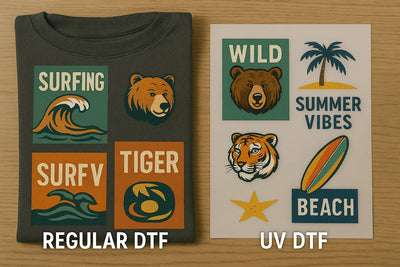
Regular DTF (Direct to Film) is a method of printing full-color designs onto a special film, applying adhesive powder, and then heat-pressing it onto fabric.
It’s the go-to for:
-
Cotton, polyester, and blends
-
T-shirts, hoodies, tote bags, and more
-
High-detail, full-color prints
-
Long-lasting durability
In-house production follows this sequence: print the design, apply adhesive powder to the wet ink, remove excess powder, cure according to the material and equipment instructions, then press onto a compatible garment. Purchased ready-to-press transfers are already printed and cured; no extra powder or separate film curing is needed.
What Is UV DTF?
UV DTF uses a completely different process. Instead of heat-pressing onto fabric, UV DTF uses UV-cured ink on a clear adhesive sheet that is peeled and applied directly onto hard surfaces — no heat required.
It’s perfect for:
-
Cups, mugs, tumblers
-
Compatible phone cases, laptop covers, smooth sealed or coated wood, and suitable plastics
-
Signs, packaging, and gifts
UV DTF is a pressure-applied transfer for compatible hard goods.
Check Wood and Other Surface Finishes Before Applying
For wood projects, use only a suitable smooth, sealed or coated surface after confirming compatibility. Raw, rough, porous, dusty, or unfinished wood may prevent full adhesive contact and cause lifting. A coating alone does not guarantee adhesion: test the actual item and finish before a batch.
Clean the surface using a method compatible with the item and transfer instructions, then let it dry. Remove the backing as directed, position the design, apply firm even pressure, and slowly remove the transfer film while checking that the design remains on the item. Purchased UV DTF transfers require no garment heat press or additional UV curing.
Key Differences Between UV DTF and Regular DTF
|
Feature |
Regular DTF |
UV DTF |
|
Substrate |
Fabrics (cotton, poly, blends) |
Compatible hard surfaces: glass, suitable plastics, and smooth sealed or coated wood |
|
Application |
Heat press required |
Peel-and-stick |
|
Durability |
Durability depends on correct application and garment care |
Performance depends on the surface, application, exposure, and care |
|
Look/Finish |
Transferred print on fabric; feel varies with artwork coverage and materials |
Glossy, vibrant decal-style look |
|
Use Cases |
Apparel, tote bags, uniforms |
Tumblers, signs, packaging, labels |
When to Use UV DTF
Choose UV DTF for a compatible hard surface. An item being unsuitable for a heat press does not automatically make it suitable for UV DTF. Common project types include:
-
Custom cups and drinkware
-
Business branding on hard goods
-
Gifts and promo items
-
Durable stickers and labels
Check fit and placement before removing the backing. Follow the supplied application and care instructions, and test the actual surface before production. Do not assume dishwasher-safe, scratch-proof, or outdoor-rated performance without product-specific confirmation.
When to Use Regular DTF
Regular DTF is ideal when you’re working with:
-
Clothing and apparel
-
Custom shirts for teams, events, or brands
-
Multi-design gang sheets
-
Print-on-demand fashion items
If you're pressing onto fabric, regular DTF is the winner.
Applying Current DTF Dallas Garment Transfers
For current standard DTF Dallas garment transfers on a manual heat press, use 290–310°F (approximately 143–154°C), 8–15 seconds, and medium-to-high even pressure. Keep the garment flat and hot peel the clear carrier promptly after pressing. Test the exact garment, particularly for heat marks or dye migration, and follow the current application guide. A finishing press is optional; follow the guide if using one. These garment settings do not apply to UV DTF.
Why DTF Dallas Offers Both Options
At DTF Dallas, we support your full range of printing needs. That’s why we provide:
-
✅ Standard DTF gang sheets for apparel
-
✅ UV DTF transfers for hard goods
-
✅ Same-day shipping for print-ready orders placed before 2:00 PM CT, Monday through Saturday
-
✅ No printer required — just upload, and we print
Custom printing requires print-ready artwork before the shipping cutoff. Same-day shipping means dispatch, not arrival. See the Shipping Policy for delivery details.
👉 Explore UV DTF options now
👉 Order standard DTF gang sheets
Conclusion
Both UV DTF and regular DTF have their place — it’s all about matching the method to the material.
-
For shirts, hoodies, and fabric: go with regular DTF
-
For compatible cups, smooth sealed or coated wood, suitable plastics, or metal: choose UV DTF
Want to try both? Upload your files and get premium-quality prints from DTF Dallas — fast.
Comments 0
Be the first to leave a comment.