
Why Your DTF Print Feels Like Plastic and How to Fix It
Aug 4, 2026 (Updated on Sep 30, 2026)
A well-pressed DTF transfer should have a soft, slightly flexible hand feel. The fabric around the design stays soft, and the design itself has a thin film feel without the rigid, plastic-like stiffness that signals something went wrong.
If your DTF prints feel like a hard plastic shell sitting on top of the fabric, one of four things caused it, and each has a direct fix.
Jump to any section
- What "soft hand" actually means
- Cause 1: over-pressing
- Cause 2: design size and fill coverage
- Cause 3: too much adhesive powder
- Cause 4: film type
- Does DTF soften after washing?
- The finishing press and hand feel
- Setting customer expectations
- FAQ: DTF plastic feel answered
Quick answer: why does my DTF print feel like plastic?
A DTF print feels like plastic for one of four reasons: over-pressing (too hot or too long), a large solid-fill design covering a big film area, too much adhesive powder, or a heavy, stiff film type. Over-pressing is the most common. Press at the DTF Dallas standard of 290 to 310°F rather than hotter, since more heat makes transfers brittle, not more durable. A correctly pressed transfer softens slightly after the first few washes. DTF Dallas produces transfers with consistent adhesive coating and standard film weight.
What "Soft Hand" Actually Means for DTF
Soft hand is the industry term for how decoration feels on a garment. DTF transfers are inherently slightly stiffer than the surrounding fabric because the adhesive film and ink layer add structure, but this stiffness should be minimal.
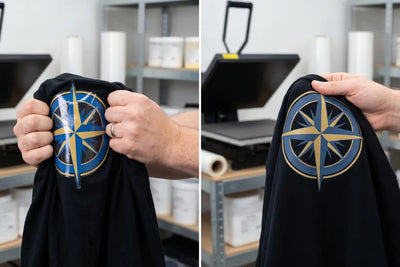
On a cotton jersey shirt, a properly applied DTF transfer should feel similar to a slightly thicker area of fabric. The design edges should not feel raised or rigid. The plastic feel that customers and decorators complain about is not an inherent DTF problem. It is a symptom of a specific process error.
The DTF hand-feel scale
Soft · correct press Slightly stiff · large fill Plastic · process error
A correct press lands on the left. Large solid designs sit naturally in the middle. A hard plastic shell on the right always points to a fixable process error, not to DTF itself.
01Over-Pressing
Over-pressing is the most common cause of hard, plastic-feeling DTF prints. When a transfer is pressed at too high a temperature or for too long, the adhesive flows more than necessary into the fabric, and the film layer on top can partially melt or harden into a denser surface.
How to identify
The design area feels rigid when you flex the garment. The print may also look slightly shiny compared to a correctly pressed transfer.
Fix
Reduce temperature and test on a scrap piece. If you are pressing above the standard range or longer than recommended, reduce both. A transfer does not become more durable with more heat. It becomes more brittle and rigid.
Temperature290 to 310°F
High pressure6 seconds
Medium pressure8 to 15 seconds
Finishing press5 seconds (silicone sheet)
02Design Size and Fill Coverage
Large, solid-fill designs produce a stiffer feel than smaller designs or designs with lower ink coverage. A full front print covering 12 by 14 inches of solid color lays a continuous film across a large area of fabric. Even when correctly pressed, that film covers enough surface area that the stiffness becomes noticeable. This is physics, not a press error. More film area equals more stiffness.
How to identify
The print feels plastic but the settings were correct, and the design is large or has near-100% ink coverage.
Fix
For large designs, set customer expectations. Some stiffness on large full-front prints is normal and improves slightly after the first few washes. If the design can be modified, an open design with more negative space (visible fabric inside the design boundary) uses less film and produces a softer hand.
03Too Much Adhesive Powder
On self-produced DTF prints, where you print, powder, and cure your own transfers, excess hot-melt adhesive powder produces a thick adhesive layer. When pressed, this thick layer creates a stiff feel because there is more polymer film between the ink and the fabric.
How to identify
The film feels unusually thick when you handle the unapplied transfer. The design edges may have a slightly gummy or rough texture before pressing.
Fix
Shake excess powder from printed transfers before curing. The powder should coat the wet ink evenly without clumping or buildup. A thin, consistent coating produces a thin adhesive layer after pressing. If you order pre-printed transfers and the feel is consistently stiff, the supplier may be over-powdering, so compare a different supplier or contact them.
04Film Type
DTF film comes in different weights and formulations. Thicker, stiffer carrier films produce stiffer final results. Most standard DTF transfers use a film that balances durability with hand feel, but some budget production uses heavier film that saves cost and produces a noticeably harder feel.
How to identify
The unapplied transfer feels heavy and rigid compared to other transfers you have worked with. Held up to light, it may appear thicker than usual.
Fix
If you produce your own transfers, specify a softer-hand film from your supplier. If you purchase transfers, ask about film weight options. Some suppliers offer a soft-hand or thin-film option for applications where hand feel matters most.
Does DTF Soften After Washing?
Yes, somewhat. A correctly applied DTF transfer softens slightly after the first few wash cycles. The adhesive settles more firmly into the fabric fibers, and the film layer becomes slightly more supple with washing. This is normal and expected.
What does not improve with washing is rigidity caused by over-pressing. Over-pressed transfers may crack or peel as the rigid adhesive layer breaks down under repeated flexing and washing. A print that feels like hard plastic immediately after pressing will not soften into a good feel. It will crack first.
The Finishing Press and Hand Feel
The finishing press, placing a silicone sheet over the applied transfer and pressing for 5 seconds at the same temperature, does not make the hand feel worse. It actually seats the adhesive more evenly, which can slightly reduce visible stiffness at the design edges.
The finishing press is recommended for all DTF applications, including those where hand feel is a priority. For the full peel and finishing sequence, the step-by-step guide to applying DTF transfers ready to press covers the complete post-press workflow.
Setting Customer Expectations
If a customer wants DTF decoration on a premium soft-hand fabric like rayon, modal, or bamboo jersey, be direct about what the result will feel like. DTF always adds some structure to the decorated area. The softer the surrounding fabric, the more noticeable the contrast between the fabric and the transfer.
The guide to the best fabrics for DTF transfers covers the hand feel trade-off on soft fabrics, one of the key points decorators need to set expectations around before the customer gets the garment. For fabric-specific applications where hand feel is a top concern, smaller designs in the 2 to 4 inch range are the easiest path to a result the customer will be happy with.
Consistent coating, standard film. DTF Dallas produces custom DTF transfers with consistent adhesive coating and standard film weight, ships same-day on print-ready files before 2:00 PM CST, and carries no order minimum, so you can test the hand feel on a single piece before a run.
Frequently Asked Questions
Why does my DTF print feel like plastic?
A DTF print feels like plastic for one of four reasons: over-pressing, a large solid-fill design, too much adhesive powder, or a heavy film type. Over-pressing is the most common, so press at the DTF Dallas standard of 290 to 310°F rather than hotter, since extra heat makes the transfer brittle, not more durable. Order transfers with consistent coating from the DTF transfer collection.
How do I make my DTF transfers softer?
Press at 290 to 310°F rather than hotter, use a thin, even adhesive powder coating, choose a soft-hand film, and keep large solid fills to a minimum by adding negative space. A finishing press with a silicone sheet seats the adhesive evenly and can reduce edge stiffness. DTF Dallas uses consistent coating and standard film weight. Order from the DTF transfer collection to compare hand feel.
Does DTF soften after washing?
Yes, somewhat. A correctly applied DTF transfer softens slightly after the first few wash cycles as the adhesive settles into the fibers and the film becomes more supple. Rigidity caused by over-pressing does not improve, though, and an over-pressed transfer cracks before it softens. Press correctly the first time. DTF Dallas transfers are tested to 50 or more washes. Order from the DTF transfer collection.
Why is my large full-front print so stiff?
A large solid-fill design lays a continuous film across a big area of fabric, so even a correct press feels stiffer than a small design. This is physics, not a press error, since more film area means more stiffness. Add negative space to the design to use less film, or set the expectation that large prints soften slightly after a few washes. DTF Dallas prints large-format transfers, available in the DTF transfer collection.
Does a finishing press make DTF feel more like plastic?
No. A finishing press with a silicone sheet for 5 seconds at the same temperature does not make the hand feel worse. It seats the adhesive more evenly and can slightly reduce visible stiffness at the design edges. DTF Dallas recommends a finishing press for all applications, including soft-hand priorities. Order transfers matched to these settings from the DTF transfer collection.
Will DTF feel soft on rayon or bamboo shirts?
DTF always adds some structure, so on premium soft-hand fabrics like rayon, modal, or bamboo jersey, the contrast between the soft fabric and the transfer is more noticeable. For these fabrics, smaller designs in the 2 to 4 inch range give the softest result. DTF Dallas produces transfers with standard film weight and can advise on hand feel. Contact the shop through the contact page before ordering.
Order Soft-Hand DTF Transfers from DTF Dallas
Consistent adhesive coating · Standard film weight · Same-day before 2 PM CST
Order DTF transfers →A plastic-feeling DTF print is almost always fixable. Check the press first, since over-pressing is the most common cause, then look at design fill, powder coating, and film type. A correct press at 290 to 310°F, a thin even powder coat, a soft-hand film, and a finishing press give you the soft, flexible result DTF is capable of. For consistent coating and standard film weight across every piece, DTF Dallas produces transfers built for a soft hand.
Comments 0
Be the first to leave a comment.