
Stored DTF Transfers can curl at the edges when their carrier film is exposed to moisture, temperature changes, or physical stress from rolling and uneven storage. A slightly curled edge does not automatically mean the transfer is unusable. However, permanent creases, adhesive damage, or contamination can affect how the design bonds to fabric.
For garment decorators who keep extra transfers for future orders, the important decision is whether the film has simply changed shape or the transfer itself has deteriorated. Understanding that difference helps prevent wasted garments, unnecessary reorders, and production interruptions.
This guide explains why edge curling happens, how to inspect stored transfers, and what to do before starting your next shirt run.
Quick Answer
Stored DTF Transfers typically curl at the edges because of humidity, temperature fluctuations, or pressure from improper storage. Mild curling may be manageable if the printed design and adhesive remain intact.
Place the transfer on a clean, dry, flat surface, inspect it for damage, and test one piece before full production. If the film has permanent creases, damaged adhesive, or contamination, replacing the affected transfer is the safer choice.
What Edge Curling Means Before Pressing
A ready-to-press DTF Transfer consists of a printed design and heat-activated adhesive carried on a film. During application, the adhesive bonds the design to the fabric, and the carrier film is removed.
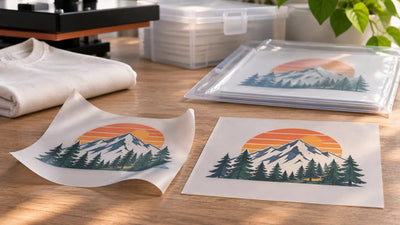
When the edges of an unused transfer rise away from a flat surface, the carrier film has developed a curve. This may happen gradually during storage, particularly when the film lacks adequate support or experiences changing environmental conditions.
A small amount of curvature can make positioning more difficult. An edge that will not stay in place may shift during handling, especially when aligning a detailed design on a garment.
The degree of curling matters, but appearance alone cannot establish whether the adhesive will perform correctly.
Curled Carrier Film vs. Print Edges Lifting After Pressing
These problems occur at different stages and require different checks.
Carrier film curling before pressing means the unused transfer bends upward or rolls toward itself. Start by examining its storage conditions, physical shape, printed artwork, and adhesive.
Print edges lifting after pressing means part of the transferred design is not properly bonded to the garment. Possible causes include uneven platen contact, unsuitable application conditions, moisture in the garment, or a problem with the transfer.
If the design lifts after application, inspect pressure distribution, garment seams, positioning, and the product's pressing instructions. Do not assume the original film curvature caused the bonding problem.
Why Stored DTF Transfers Begin to Curl
Humidity and Temperature Changes
Humidity is one of the main environmental factors associated with DTF Transfer film curling.
High moisture exposure can affect the carrier film and may also interfere with the adhesive layer. In some cases, moisture exposure is accompanied by clumping or irregular adhesive texture.
These are related concerns, but they are not identical. A curved film can still have an intact adhesive layer, while a transfer that appears relatively flat may have experienced unfavorable storage conditions.
Temperature fluctuations can also contribute to changes in film behavior. Moving transfers repeatedly between hot and cool environments may place stress on the film and its layers.
A storage space with relatively stable indoor conditions is preferable to an area where temperature and humidity change substantially throughout the day.
Rolling, Bending, and Uneven Storage Support
Physical storage conditions can cause a transfer to retain a curved shape even without obvious moisture damage.
Common situations include:
- Keeping small transfers tightly rolled instead of flat.
- Allowing larger sheets to hang over the edge of a shelf.
- Folding gang sheets to fit into undersized containers.
- Stacking heavy objects on unsupported transfer edges.
- Leaving transfers compressed inside unsuitable packaging.
A loosely rolled, protected gang sheet is different from a sheet that has been sharply folded. Gentle curvature may relax when the film is laid flat, while a sharp crease can permanently distort the carrier or printed design.
For smaller transfers, flat storage generally provides the most straightforward way to reduce mechanical stress.
Heat Exposure and Adhesive Contamination
Direct sunlight, nearby heaters, and other heat sources can create unfavorable storage conditions.
Excessive heat can affect the adhesive before its intended application. Dust, oils, and moisture can also contaminate the printed or adhesive surface when transfers are left uncovered or handled carelessly.
A transfer exposed to these conditions may develop visible abnormalities, including irregular adhesive texture or areas that stick together.
Protecting the transfer from contamination matters just as much as preventing the film from bending.
Can You Still Use a Curled DTF Transfer?
A mildly curled transfer may still be usable, but it should pass inspection and a test application before being used for a production order.
The decision should depend on the condition of the entire transfer, not simply the height of the curled edge.
Check the Film, Ink, and Adhesive
Use the following checks to distinguish manageable curvature from more serious problems.
| Observable condition | First check | Recommended action |
|---|---|---|
| Slightly raised edges with a smooth design | Inspect the film and adhesive for creases or irregularities | Lay flat gently and test one transfer |
| Sharp folds or permanent creases | Look for distortion crossing the printed artwork | Replace transfers with visible structural damage |
| Clumped, patchy, or separating adhesive | Examine whether the adhesive layer remains consistent | Keep affected pieces out of production and replace visibly damaged transfers |
| Dust, oil marks, or moisture stains | Check whether contamination reaches the design or adhesive | Replace contaminated pieces that cannot be used reliably |
| Transfer edges lifting from fabric after application | Examine platen contact, fabric condition, and press settings | Diagnose the application process rather than treating it as film curling |
A transfer that looks normal is not automatically guaranteed to press correctly. Likewise, mild curvature alone is not proof of adhesive failure.
The most useful confirmation is a test on a compatible garment under the intended application conditions.
Flatten Gently and Test Before a Batch
When a stored transfer shows mild curling without visible damage, follow this sequence:
- Inspect the transfer. Handle it with clean, dry hands. Check the carrier, printed artwork, and adhesive for creases, contamination, clumping, or separation. Set aside visibly damaged pieces.
- Allow the film to relax. Place the transfer on a clean, dry, flat surface with its printed and adhesive areas protected from contact. Give it several hours to settle naturally. Use gentle, even support if needed, without pressing heavy objects directly onto the design. Avoid hair dryers, heat guns, or other unapproved heating methods.
- Prepare a test garment. Choose a spare piece made from the same fabric as the intended order, preferably with a similar finish and thickness. Make sure the application area is clean and flat. A brief pre-press can remove surface moisture and wrinkles where the garment permits it.
- Apply the transfer using its product instructions. For standard DTF Dallas Transfers with a manual heat press, use 290 to 310°F, medium to high even pressure, and 8 to 15 seconds, followed by a hot peel. Position the adhesive side against the garment with the carrier above it. Keep the fabric flat and peel the carrier smoothly while hot. Garment materials and presses vary, so establish a suitable setting within the stated guidance through a sample test.
- Inspect the finished design. After application and cooling, examine the artwork for complete transfer, smooth edges, and consistent adhesion. If the design fails to transfer properly, do not proceed with the remaining batch until the cause is identified.
The DTF Dallas application and care instructions provide additional product-specific guidance on heat-press setup and garment compatibility.
A successful sample helps establish whether the tested transfer and garment combination is suitable. Other pieces showing different damage still need individual inspection.
How to Store DTF Transfers So They Stay Flat
Good storage protects three things: the carrier film's physical shape, the adhesive layer, and the printed artwork.
Store Cut Transfers and Gang Sheets Correctly
Cut transfers: Keep individual pieces flat in appropriately sized, clean protective sleeves, folders, or rigid storage boxes. Support the entire sheet so that corners do not hang over an edge.
Avoid overcrowding containers or placing substantial weight on the printed surfaces.
Gang sheets: Store cut sections flat whenever space permits. If a long sheet arrives rolled, keeping it loosely rolled inside suitable protective packaging may be reasonable when flat storage is impractical.
Avoid tight rolling, sharp folding, and compression. Before pressing, carefully unroll the required section and allow it to lie flat.
The goal is to avoid introducing bends that remain after the transfer has been removed from storage.
Use Protective Packaging and Stable Room Conditions
Choose a dry, indoor storage location away from direct sunlight, heating equipment, and places where condensation can develop.
Protective sleeves or closed containers reduce exposure to dust and handling damage. Where humidity is a concern, a suitable moisture-control packet inside the storage container may help, provided it does not touch or damage the transfers.
A simple workshop storage routine includes:
- Inspect transfers when they arrive.
- Keep cut pieces flat with adequate support.
- Protect long sheets from tight rolling and folding.
- Store transfers away from moisture, sunlight, and excess heat.
- Label packages with their receipt date and design.
- Use older stock first when its condition is suitable.
- Inspect stored transfers again before a production run.
What about shelf life?
DTF Transfer shelf life depends on the product and its storage history. Different manufacturers provide different time recommendations, so one universal expiration period is not appropriate.
DTF Dallas indicates that properly stored transfers can remain usable for months and recommends testing older stock before full production.
Instead of assuming a transfer is usable solely because it has been stored for a certain number of weeks, evaluate its condition and how it performs during a sample application.
A Practical Example: Checking Transfers Before a Shirt Run
Consider a hypothetical decorator preparing an order for 20 cotton T-shirts.
The decorator has 24 previously stored transfers of the same design. Eighteen lie flat, while six have slightly curled edges. There are no obvious creases or adhesive clumps.
Rather than pressing the 20 customer shirts immediately, the decorator selects one flat transfer and one curled transfer for testing on two separate spare cotton garments.
Both tests use the same garment type, design placement, and appropriate heat-press settings. The operator checks whether each design transfers completely and whether the edges remain attached after cooling.
Two possible outcomes lead to different decisions.
If both samples pass: There are 22 unused transfers remaining for the 20-shirt order. The operator can inspect the remaining pieces and proceed, with two additional transfers available as a buffer.
If the curled sample fails but the flat sample passes: The remaining five curled pieces should not automatically enter production. That leaves 17 untested flat transfers, meaning at least three more potentially usable transfers are needed to complete the 20 shirts. Additional replacements and a reasonable spare quantity may be necessary.
The numbers are illustrative, but the decision process is useful: identify the affected stock, test comparable samples, count the pieces that remain suitable, and address the shortage before decorating customer garments.
When to Reorder Instead of Risking a Garment
A transfer is worth replacing when visible damage affects the artwork or adhesive, or when a properly conducted sample test indicates unreliable performance.
The cost of applying a questionable transfer is not limited to the transfer itself. A failed application may also consume a garment and interrupt the production schedule.
DTF Dallas offers two relevant ordering options.
For a single design or a small replacement quantity, DTF Transfers by Size lets decorators order ready-to-press transfers without producing the prints themselves.
For an order containing multiple designs, sizes, or repeated artwork, the DTF Gang Sheet Builder allows different designs to be arranged on a shared sheet.
Both options provide the same type of ready-to-press fabric transfer. Selecting a gang sheet does not change the product's hot-peel application requirements.
For businesses with intermittent orders, smaller, better-planned replenishment quantities can also reduce how long unused stock remains in storage. Ordering format alone does not prevent curling, but improved inventory planning can reduce unnecessary storage exposure.
Frequently Asked Questions
Can I use a hair dryer to straighten curled DTF Transfers?
No. Heating a stored transfer with a hair dryer or heat gun is not a recommended flattening method, because excess heat can affect the film or adhesive. Let mildly curled DTF Dallas transfers rest for several hours on a clean, dry, flat surface, then press one test piece at 290 to 310°F before the batch.
Does airtight packaging repair moisture-damaged transfers?
No. Protective packaging limits future moisture exposure, but it does not restore an adhesive layer that is already damaged. Inspect the DTF Dallas transfer for clumped or patchy adhesive, press one sample on a spare garment, and replace any piece that fails.
Should I keep long DTF Transfer gang sheets rolled?
Yes, when flat storage is impractical. A long DTF Dallas gang sheet that arrives rolled can stay loosely rolled in suitable protective packaging. Avoid tight winding and sharp folds, and let the required section relax on a flat surface before pressing.
How often should stored transfers be inspected?
At least twice: when they arrive and again before use. Add a check after prolonged storage or known exposure to heat, moisture, or unsuitable handling. Label each DTF Dallas package with its receipt date and design, and test older stock on one garment before a full order.
The Practical Takeaway
Stored DTF Transfers usually develop edge curling because of environmental exposure or physical stress during storage. Mild curvature does not necessarily make a transfer unusable, but adhesive damage, permanent creases, and contamination require closer attention.
The most effective approach is to store transfers flat whenever practical, protect them from heat and moisture, and test questionable pieces before production.
For garment decorators, a few minutes spent checking stored transfers can protect both the finished shirts and the time invested in completing an order.
Comments 0
Be the first to leave a comment.