
Will AI Design Tools Make T-Shirt Artists Obsolete? An Honest Look
Dec 31, 2025
Scroll through any social media feed today, and you’ll see it: stunning, surreal, and incredibly detailed artwork with a caption that reads, "Made with Midjourney," or "Generated by DALL-E." Artificial intelligence has exploded into the creative world, and its capabilities are evolving at a breathtaking pace. From photorealistic portraits to fantastical landscapes, AI can now generate complex images from a simple text prompt in a matter of seconds.
For those in the custom apparel and DTF printing industry, this raises a profound and slightly uncomfortable question: Is this the end of the line for human t-shirt artists?
If a machine can generate dozens of professional-looking designs in the time it takes to brew a cup of coffee, what is the future role—and value—of a human designer? It’s a valid concern, and one that deserves more than a simple "yes" or "no" answer. The reality is far more nuanced.
This isn't a story about extinction; it's a story about evolution. While AI is undeniably a disruptive force, it is not a replacement for the human heart and mind. Let’s take an honest, balanced look at what AI art generators can do, where they fall short, and how the role of the t-shirt artist is set to become more important than ever.

What AI Design Tools Can Do (and Why It's Genuinely Impressive)
To have a credible discussion, we first have to acknowledge the raw power of these new tools. It would be foolish to dismiss them. AI art generators bring three game-changing capabilities to the table.
1. Unprecedented Speed and Idea Generation
This is AI's most undeniable strength. An artist might spend hours sketching out a few initial concepts for a client. An AI, on the other hand, can take a prompt like, "A vintage-style illustration of an astronaut surfing on a cosmic wave," and produce four completely different, high-quality interpretations in under a minute. For brainstorming and rapid ideation, this is a superpower. It allows for a level of visual exploration that was previously unimaginable in such a short timeframe.
2. Instant Access to Diverse Styles
Mastering a new artistic style—be it art nouveau, Japanese woodblock, or 90s cartoon—can take a human artist years of dedicated practice. An AI can mimic that style instantly. By simply adding "in the style of..." to a prompt, a user can generate images that capture the aesthetic of almost any art movement or famous artist in history. This allows for incredible stylistic flexibility without the steep learning curve.
3. Lowering the Barrier to Entry
Perhaps most significantly, AI democratizes image creation. Someone with a brilliant t-shirt idea but zero traditional drawing skills can now bring their vision to life. They can generate a visually appealing graphic that, at first glance, looks ready to be printed on a shirt with a DTF printer. This opens up the world of custom apparel to a much wider audience of creators and entrepreneurs.
The Human Element: Where AI Currently Falls Short
Given those impressive capabilities, it’s easy to see why artists are concerned. But creating a technically proficient image is only one part of designing a great t-shirt. A t-shirt isn't just a canvas; it's a piece of communication, a statement, and a product that needs to be manufactured. This is where the limitations of AI become glaringly obvious.
1. The Lack of "Why" – Intent and Storytelling
AI is a master of the "what," but it has absolutely no understanding of the "why." A great t-shirt design connects with an audience on an emotional level. It tells a story, shares an inside joke, captures the spirit of a brand, or makes a powerful statement. This requires a uniquely human understanding of culture, context, and emotion.
An AI can generate a cool picture of a wolf, but a human artist can design a wolf that embodies the spirit of a local high school mascot, captures the lone-wolf mentality of a motorcycle club, or illustrates a specific scene from a beloved fantasy novel. AI creates images; humans create meaning.
2. Taste, Curation, and Composition
Anyone who has used AI art generators knows that for every one stunning image, there are nine bizarre, cluttered, or nonsensical ones. AI often struggles with creating a balanced and focused composition. It might add too many elements, put things in strange places, or generate anatomically incorrect figures (the infamous six-fingered hand).
The role of a human artist is to act as a curator and an editor. They use their sense of taste and their understanding of visual hierarchy to create a design that is not just cool, but also clear, balanced, and aesthetically pleasing. They know how to arrange elements so the design works on the unique canvas of a t-shirt—whether it's a small left-chest print or a full-back masterpiece.
3. The Nuances of Typography and Text
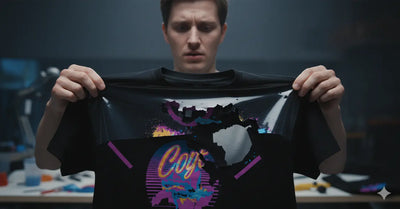
This is one of AI's most significant weaknesses. While it is improving, AI still struggles mightily with generating clean, correct, and well-designed text. It often misspells words, creates bizarre letterforms, and has no understanding of kerning, leading, or the art of typography.
Typography is a deep, complex, and expressive art form. A human designer can choose the perfect font to evoke a specific mood—be it retro, modern, elegant, or grunge. They can skillfully integrate text with imagery to create a cohesive and powerful message. For the vast majority of t-shirt designs that include text, a human touch is still essential.
4. Technical Preparation for Print
This is a critical, behind-the-scenes step that AI completely ignores. An image generated by an AI is rarely "print-ready." It often contains stray pixels, messy edges, and other digital artifacts. It might be the wrong resolution (DPI) or color profile.
A professional designer knows how to take a raw image and prepare it for the physical printing process. They clean up the artwork, ensure it has a transparent background, check the resolution, and export it in the correct file format for their DTF printing supplies and software. This technical skill is the bridge between a cool digital picture and a high-quality, sellable physical product.
The New Reality: AI as a Tool, Not a Replacement
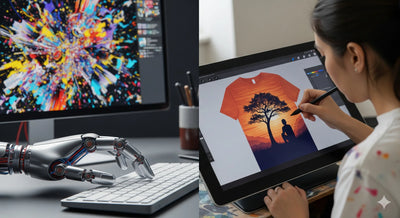
The conversation shouldn't be "Human vs. AI." It should be "Human + AI." The smartest t-shirt artists and DTF business owners are not running from these new tools; they are embracing them as incredibly powerful assistants that can augment, not replace, their unique human skills.
The AI-Powered Mood Board
Instead of spending hours searching Pinterest for inspiration, an artist can now use AI as an infinite idea generator. By feeding it prompts, they can create a dozen different visual directions for a project in minutes. They can then use these AI-generated images as a starting point or a "mood board," cherry-picking the best elements and using their own skills to combine and refine them into something new and original.
Creating Textures and Background Elements
Need a unique, seamless pattern for a background? Or a specific grunge texture to distress a design? AI is brilliant at this. An artist can use AI to generate these supporting assets, which they can then import into Photoshop or Illustrator and incorporate into their main, human-led design. This saves time on tedious work and allows the artist to focus on the more important creative aspects.
The Artist as a "Creative Director"
This is the most important evolution. The role of the t-shirt artist is shifting from "pixel pusher" to "creative director." The artist is the one with the vision, the taste, and the understanding of the client's needs. They can now use AI as a junior assistant. They direct the AI to generate raw visual materials, and then they use their expertise to curate, edit, refine, and technically prepare those materials into a final, polished, and professional product. The human is the pilot; the AI is the navigation system.
Creativity is Still the Killer App
So, will AI design tools make t-shirt artists obsolete? No. But they will almost certainly make artists who refuse to adapt obsolete.
AI is a powerful tool, but it lacks intent, taste, storytelling ability, and technical print knowledge. It cannot consult with a client, understand a brand's ethos, or create a design that resonates with a specific community's inside jokes. It cannot create meaning.
The future of t-shirt design belongs to the artists who can leverage AI to handle the grunt work of ideation and asset creation, freeing them up to focus on the things that truly matter: crafting compelling stories, creating balanced compositions, mastering typography, and delivering a technically perfect file that prints beautifully.
Your creativity, your empathy, and your unique human perspective are not features that can be replicated by a machine. They are, and will continue to be, your most valuable assets.
💬 Frequently Asked Questions About AI
-
Q1: Can I legally use AI-generated images for commercial t-shirt designs?
- A: This is a complex and evolving area of copyright law. Currently, the U.S. Copyright Office has stated that works created solely by AI without human authorship are not eligible for copyright protection. This means that while you can use them, others might be able to use the same or similar images as well. The law is still developing, so it's a "use at your own risk" scenario.
-
Q2: Are AI images good enough quality for DTF printing?
- A: It depends. Many AI generators can now produce high-resolution images. However, the raw output is often not "print-ready." It may contain digital artifacts, messy edges, or be in the wrong color space (RGB instead of CMYK). A human designer is almost always needed to clean up and prepare the file for a professional DTF printer.
-
Q3: As a business owner, should I hire a designer or just use AI?
- A: For generic stock-style images, AI can be a starting point. But for creating a unique brand identity, custom logos, or designs that tell a specific story, hiring a human designer is an investment that will always pay off. A human designer becomes a creative partner who understands your vision, which is something AI cannot do.
Comments 0
Be the first to leave a comment.